

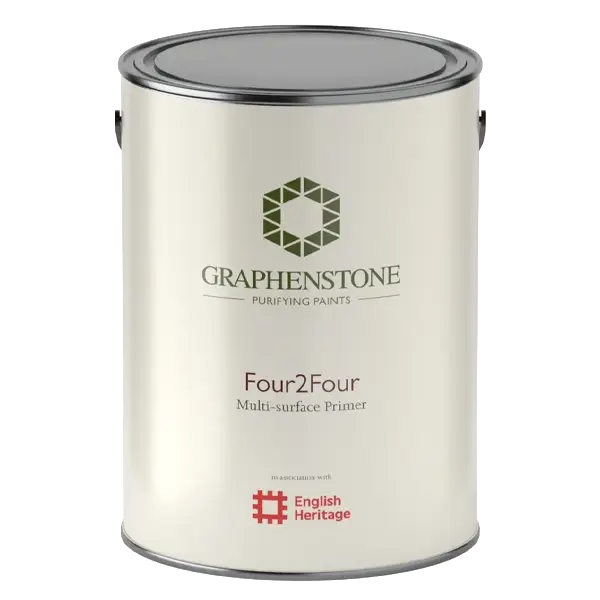


Graphenstone Four2Four is useful when a decorating project includes backgrounds that need specialist preparation before applying the chosen paint. Typical uses include renovating previously painted joinery, decorating MDF and updating glazed tiles or plastic fittings.
Choose it when moving from an existing coating to a compatible Graphenstone finish, or when preparing several different materials within the same project. Select the finishing paint according to the surface, location and expected wear, and complete a test area before starting work.
Suitable for correctly prepared interior and exterior wood, MDF, ceramics, tiles, plastics, glass and non-ferrous metals, as well as firmly adhered existing paintwork. Remove corrosion or oxidation and apply a suitable rust-inhibiting primer where required. Not suitable for surfaces in permanent contact with water.
Explore these Graphenstone finishing paints, checking suitability for the surface and location.
| Product | Use |
| Graphenstone GrafClean Matt Paint | Washable matt paint for interior walls and ceilings. |
| Graphenstone GrafClean Eggshell | Washable low-sheen finish for interior walls, ceilings and suitably primed woodwork. |
| Graphenstone Ambient Pro+ Air Purifying Matt Paint | Lime-based matt paint with light-activated air-purifying properties. |
| Graphenstone GCS Exterior Paint | Breathable matt paint for exterior walls and compatible masonry surfaces. |
| Graphenstone Siena | Decorative limewash for interior walls and ceilings, with natural tonal variation. |
Ensure that all surfaces are dry, sound, firmly adhered and free from anything that could affect adhesion.
Paint applied before the 1960s may contain lead. Special precautions should be taken during preparation, and a lead testing kit should be used if the existing coating is of an uncertain age.
We recommend trialling a test area before starting your project to check suitability and compatibility.
Mix thoroughly until the primer is uniform. Apply when the air and surface temperature is between 7°C and 35°C and the relative humidity is below 80%. Avoid applying in direct sunlight, onto sun-heated surfaces or when rain is expected.
If the primer is left exposed for more than 7 days, lightly sand the surface and remove all dust before applying the finishing paint. Clean application tools with warm water immediately after use.
Once Graphenstone Four2Four is fully dry, apply a compatible finishing paint that is suitable for the surface and its location. Use an interior wall or ceiling paint for internal decorating projects, an appropriate eggshell finish for woodwork and other surfaces requiring additional durability, or a suitable exterior paint for outdoor applications.
Four2Four helps seal stains, tannins and timber knots but does not provide the final colour or opacity. Apply sufficient coats of the chosen finishing paint to achieve a consistent appearance, following its preparation, application and drying instructions. Check the suitability of the complete coating system when decorating tiles, plastics, UPVC, glass or non-ferrous metal, particularly in areas exposed to moisture or regular wear.
It is suitable for wood, MDF, tiles, ceramics, plastics, UPVC, glass and non-ferrous metals. It can also be applied over firmly adhered primers and existing paint.
Yes, it is suitable for interior and exterior projects. Exterior surfaces should be correctly prepared and finished with a compatible exterior paint.
Yes, Four2Four can be used as a bridging coat over firmly adhered oil-based and other previously painted surfaces. Glossy finishes should be cleaned and lightly abraded before application.
It helps seal water stains, timber tannins and knots to reduce bleeding into the finishing paint. Apply a second coat over stubborn areas where required. The finishing paint provides the final colour and opacity.
Apply 1-2 coats depending on the surface, its level of absorption and the condition of the existing finish. Two coats are recommended on MDF.
Yes, it can be applied using airless or HVLP spray equipment. No thinning is required for airless application, while up to 10% clean water can be added for HVLP spraying if required.
It can be used in suitable interior and exterior coating systems but should not be applied to surfaces in permanent contact with water. Check that the selected finishing paint is appropriate for the expected level of moisture and wear.