


Projects (A-Z)
Brands (A-Z)
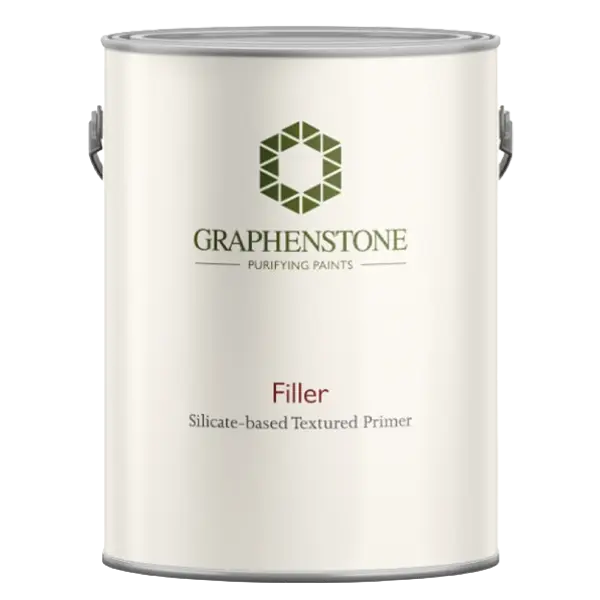
Graphenstone Filler
Breathable textured silicate primer for evening out surface textures and covering hairline cracks under 1mm.
Features
- Compatible with gypsum, lime plaster and render, brick, concrete and securely adhered existing paint, allowing use across a variety of correctly prepared surfaces.
- Suitable for interior and exterior use, providing a versatile primer for projects throughout the home.
- Class 1 vapour-open finish allows moisture vapour to pass through compatible mineral surfaces.
- Trace VOC content of less than 1g/L helps support healthier indoor environments.
- White matt finish creates a neutral base for subsequent coats of compatible Graphenstone paint.
- One-coat application by brush or roller simplifies preparation before applying the chosen finishing paint.
- Water-cleanable formulation makes brushes, rollers and other equipment easier to clean after use.
Brand
Drying time
24 hrs
Coverage
Up to 7 m2 per litre
No. of coats
1
Size
4L
MPN
Please Select Size/Option
GTIN
Please Select Size/Option
Overview
Graphenstone Filler is a white textured silicate primer for visually evening out interior and exterior surfaces before painting. Unlike a conventional repair filler, it is applied across the surface as a coating, helping disguise differences in texture between old and new materials, smooth patch repairs and uneven render. It can also cover superficial crazing and hairline cracks measuring less than 1mm, but should not be used to repair larger, deeper or structurally significant cracks.
Its mineral formulation produces a Class 1 vapour-open finish, allowing moisture vapour to pass through compatible substrates. Suitable surfaces include gypsum, lime plaster and render, brick, concrete and securely adhered existing paint. Graphenstone Filler contains trace VOCs and is normally applied as a single coat by brush or roller before overcoating with a compatible Graphenstone finish.
Suitability
Use on correctly prepared interior and exterior surfaces where minor imperfections or differences in texture could remain visible through the finishing paint.
To compare compatible decorative finishes, explore the selected Graphenstone product guide below.
| Product | Use |
| Graphenstone GrafClean Matt Paint | Durable matt finish for interior walls and ceilings requiring resistance to stains and regular cleaning |
| Graphenstone GrafClean Eggshell | Hard-wearing low-sheen finish for interior walls, ceilings and suitably prepared woodwork |
| Graphenstone GCS Interior Paint | Breathable heritage matt finish for traditional interiors and compatible mineral surfaces |
| Graphenstone GCS Exterior Paint | Breathable heritage matt finish for exterior walls, render and compatible mineral surfaces |
| Graphenstone Naturcolor Interior Matt | Breathable contract emulsion for large interior areas and rooms with lower levels of traffic |
| Graphenstone Siena | Decorative limewash paint for interior walls and ceilings, creating a matt finish with soft variations in tone |
Preparation
Preparation
Back
Ensure surfaces are dry, sound, securely adhered and free from dirt, dust, grease and other contaminants that could affect adhesion. New mineral surfaces must be allowed to cure for at least 28 days before application.
Please Note: Take care when preparing previously painted surfaces dating from before the 1960s, as they may contain lead. If in doubt, seek specialist advice before sanding or removing the existing coating.
- Remove loose, flaking or poorly adhered material by scraping and brushing back to a sound surface
- Clean away dirt, dust, grease and any other surface contamination
- Remove mould, algae and other organic growth using a suitable cleaning product, such as Barrettine Mould and Mildew Cleaner following its manufacturer's instructions
- Brush away loose salt deposits and treat persistent efflorescence with a suitable anti-salt treatment that is compatible with mineral coatings
- Repair holes and cracks measuring 1mm or more with a suitable repair product.
- Allow surfaces affected by rain, washing or cleaning treatments to dry completely before application
Application
Application
Back
Always carry out a test area before starting any project to confirm product suitability, adhesion and final appearance. Do not mix Graphenstone Filler with products from other manufacturers and follow the manufacturer's instructions on the container at all times.
Apply when both the surface and surrounding temperature are between 7°C and 35°C and relative humidity is no higher than 80%. Do not apply in direct sunlight, onto surfaces heated by the sun or when rain is expected before the coating has dried.
- Protect adjacent surfaces that are not being treated, particularly glass and timber
- Shake the container before use, then dilute Graphenstone Filler with 5% to 10% clean water
- Stir thoroughly before and during application, avoiding excessive agitation that could introduce air bubbles
- Apply one even coat using a brush or roller, such a Osmo Premium Roller, Brush and Tray Set
- Maintain a wet edge and complete one wall or continuous area at a time to help prevent visible lap marks
- Use the same dilution throughout and roll as close to edges as possible to minimise picture framing
- Work the mineral coating out thoroughly to produce an even and consistent textured finish
- Avoid applying the product too thickly, as this can extend drying times and cause micro-cracking
- Allow approximately 24 hours to dry at 25°C and 60% relative humidity, allowing longer in cooler or more humid conditions
- Protect exterior surfaces from rain for at least 24 hours after application
Clean brushes, rollers and other equipment with warm water immediately after use.
Finishing
Finishing
Back
Graphenstone Filler is a preparatory coating and should be overcoated with a compatible finishing paint once completely dry.
- Allow approximately 24 hours for the coating to dry at 25°C and 60% relative humidity
- Allow additional drying time in cooler temperatures or conditions of higher humidity
- Check that the surface is uniformly dry and free from dust or contamination before overcoating
- Apply the selected Graphenstone interior or exterior finishing paint in accordance with its manufacturer's instructions
- Use a vapour-open finishing paint where maintaining the breathability of the complete coating system is required
- Protect exterior surfaces from rain while the finishing coats dry
F.A.Q.
F.A.Q.
Back
Here are some of the most commonly asked questions about Graphenstone Filler.
Is Graphenstone Filler a conventional repair filler?
No. Despite its name, Graphenstone Filler is a textured silicate primer that is applied across a surface before painting. It helps disguise differences in texture, crazing and minor imperfections but is not intended for filling holes or repairing structural damage.
What size cracks will Graphenstone Filler cover?Graphenstone Filler can cover superficial crazing and hairline cracks measuring less than 1mm. Larger, deeper, moving or recurring cracks should be investigated and repaired with a suitable product before application.
Which surfaces can Graphenstone Filler be applied to?It can be applied to correctly prepared plaster, lime plaster or render, brick, concrete and securely adhered existing paint. Surfaces must be clean, dry, sound and free from anything that could prevent adhesion.
Can Graphenstone Filler be used indoors and outside?Yes. It is suitable for interior and exterior surfaces. When working outside, avoid applying it in direct sunlight or when rain is expected and protect the treated surface from rain for at least 24 hours.
Does Graphenstone Filler need to be diluted?Yes. Dilute the product with 5% to 10% clean water and stir thoroughly before and during application. Use the same dilution throughout each continuous area to help maintain a consistent finish.
Can Graphenstone Filler be sprayed?The current technical data sheet specifies application by brush or roller. Although some Graphenstone information mentions airless application, confirm the correct spray equipment and settings with the manufacturer before attempting to spray the product.
How long does Graphenstone Filler take to dry?Allow approximately 24 hours at 25°C and 60% relative humidity. Lower temperatures, higher humidity or heavy application can extend the drying time. Ensure the coating is completely dry before applying a compatible finishing paint.